
Devo East Network launch: Sooner or Later? Making the promise of devolution come true.
Paul Beckford
Devo Collective Member
9/02/2026
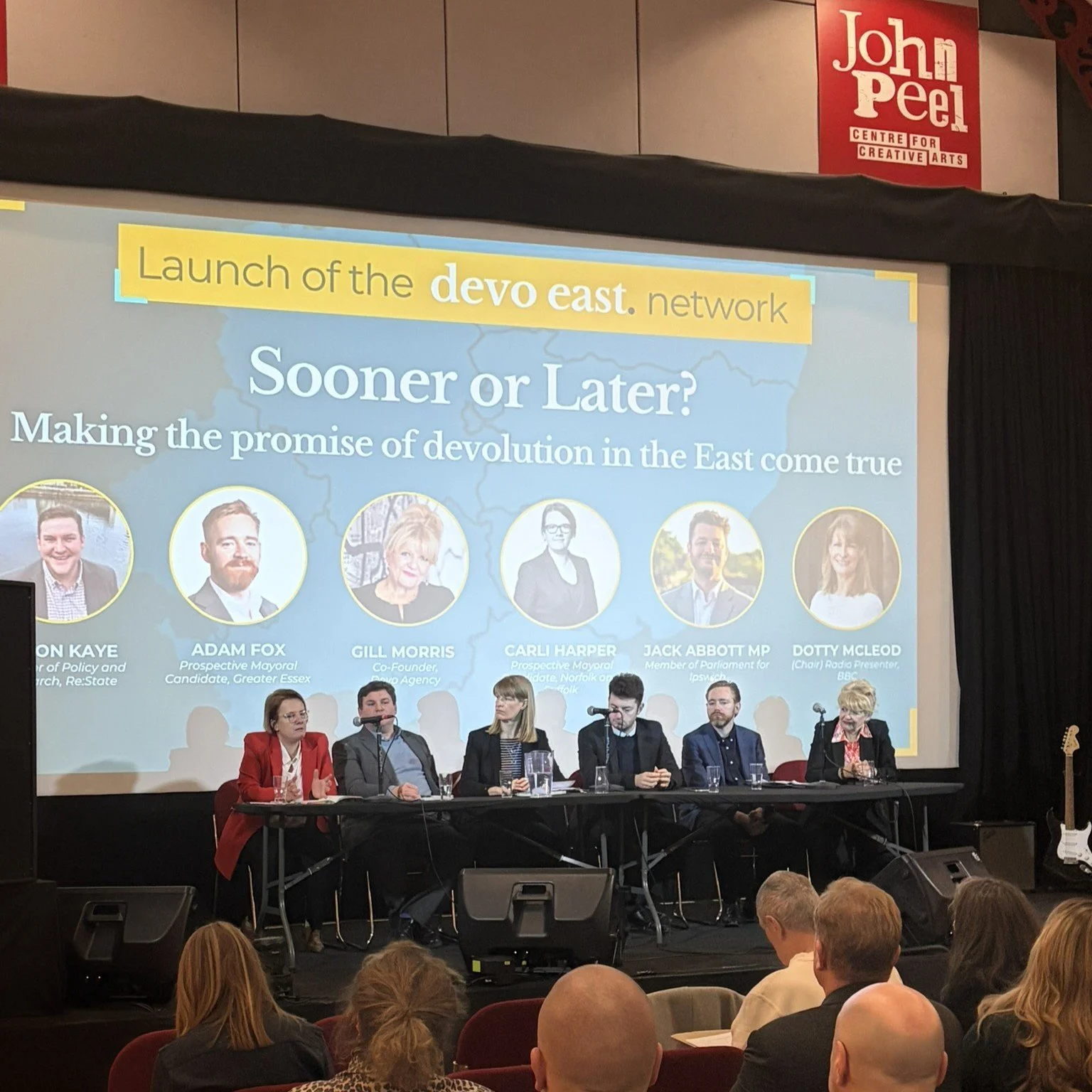
The John Peel Centre for Creative Arts in Stowmarket saw the launch of the Devo East Network, a new forum bringing together the East’s leading political, business, and civic voices to shape the conversation about the future of devolution in our region.
For too long, the East of England has been an afterthought in national conversations: a region of huge potential that has never quite been given the tools to realise it. But with devolution back on the table, the East has a unique chance to change that story. This is not just about powers and policies; it’s about serious ambition, stronger leadership, and creating a culture that is focused on delivering for local communities.
A Moment for Maturity
Jack Abbott MP for Ipswich captured it well: if the East wants to move forward, we need to get serious about ambition and leadership. For too long, a mix of amateurish behaviour and fragmented local politics has held back progress, often in response to centuries of central government control that left local places scrapping over crumbs rather than shaping their own destiny. As Simon Kaye (Head of Policy at Re:State) put it, the “infantile behaviour” of local competition isn’t innate; it was bred by a system that discouraged local trust and collaboration. Instead, he suggested what is needed is a holistic approach that embraces the interactions of different sectors and policy priorities across a region. A process he referred to as “coterminosity”.
Building a Fair, Ambitious East
With the right leadership, a mayor could do more than pull levers. Their job, as Carli Harper (Labour’s Mayoral candidate for Norfolk & Suffolk) noted, is the delivery of growth, but growth that is fair. The East is doing the heavy lifting on the clean energy revolution, so it is vital that local communities benefit from that investment. Carli strongly believes that the East should be a “shop window” for innovation: a place that showcases how sustainable industry and thriving towns can work hand in hand.
Adam Fox (Labour’s Mayoral candidate for Greater Essex) suggested that an advantage of the delay to the elections is that it provides the East time to make a clear case for what a mayor can achieve for the region. He asserted that devolution is not just about transport links, vital as they are, but a comprehensive approach covering energy, utilities, housing, and business support. Councils across Essex, Suffolk, Norfolk, and Cambridgeshire need to pull together to deliver new homes so that people can live and work where they grew up. It is the role of a Mayor to bring everyone together to make that happen.
As Carli pointed out, real places don’t stop at local authority borders. What matters is tangible outcomes for real people: housing that meets local need, jobs that anchor wealth in communities, and visible improvements that rebuild trust. Devolution provides the tools and the accountability to deliver.
A Region of Opportunity: If We Seize It
Gill Morris (Founder, Devo Agency) reminded the audience that when devolution works, it brings pace. It lets people’s voices be heard and gives government a clearer line of sight into what works on the ground. Accountability loops get shorter. Investment starts to match local priorities. But none of this will happen without collaboration and partnership across the region’s messy geography and political boundaries or “coterminosity”, as the policy world likes to call it, but really is just about working together.
And the private sector must feel the difference too. If it’s just another bureaucratic shuffle, it will fail. But if, as Adam and Carli suggested, it creates one local source of business support, helps small firms win public contracts, and keeps wealth circulating within communities, then it can be transformative.
Simon Kaye had it right: this should have happened ten years ago. But that’s no reason to settle for small steps now. The East needs a landslide of ambition, not a tweak of the system.
It is clear that devolution offers the opportunity for cultural reset, a moment to grow up as a region. It’s not just for big cities. The East’s identity depends on overcoming the old rural–urban divide and thinking as one region. The challenges are real - geography, politics, culture - but the opportunity is bigger. This is the moment to back serious leadership, practical collaboration, and the belief that the East of England can lead its own future.
