
Burnhamism; on a mission to do things differently?
Can Burnham restore a politics of purpose?
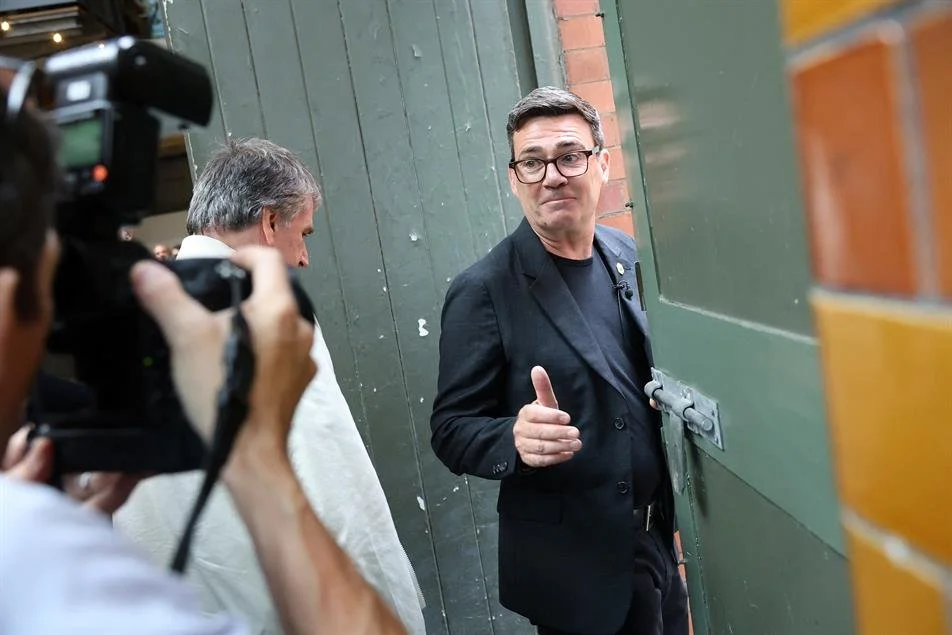
Image Credit: Planning Resource
Is mission-led Government back?
British politics is changing. How we are governed is being rewired before our eyes.
The People’s History Museum in Manchester, a monument to the radical dissent that built modern British democracy, provided the perfect backdrop for Andy Burnham to launch his leadership and give us the shape of Burnhamism to come. At the museum that displays his iconic Covid-era ‘King of the North’ jacket, the Greater Manchester mayor evoked a long history of ordinary people fighting a political status quo that rarely serves the public interest.
After years of caution, drift and managerialism, a different kind of politics is on the horizon. Andy Burnham is asking a more fundamental question: what if Westminster is no longer the centre of political power, and what if government is judged not by its press lines but by what it actually changes?
Setting matters.
Standing in Manchester’s People’s History Museum - home of Britain’s democratic and labour movements – Burnham was not simply launching a leadership pitch. He was setting out a model of government built for every postcode and place, not just Westminster and Whitehall: from communities, not departments; from local power, not central control.
Ten years ago, Burnham stood in the same building to launch his vision for Greater Manchester and his bid to become its first Metro Mayor. That speech was about possibility. This one was about proof. The Bee Network showed what happens when power is used differently: the first bus franchising in England outside London was not a technocratic footnote but a political statement that a city-region can take back control of a basic public service and make it work for the people who rely on it.
For years, Westminster has tried to pigeonhole Burnham – Blairite, Brownite, soft left, hard left. But his speech made one thing clear: he is not interested in fitting into somebody else’s tradition. He is building his own.
Call it Burnhamism if you like.
Whatever label you choose, it rests on one simple belief: Britain will not solve its economic and democratic problems until it rewires where power sits.
That is where the missions come in.
Burnham’s missions are not slogans or a communications device. They are the practical goals of a state with a regional spine:
● Better transport
● More affordable homes
● Stronger public services
● High level skills and jobs
● Fairer growth
● Healthier communities
● Public control of essential utilities
● A major council housebuilding programme
In other words, they answer a simple question: what is government for?
For Burnhamism, the answer is not endless process or centralised control. It is a state that sets clear outcomes and gives places the power to deliver them in ways that make sense locally. That means trusting local leaders rather than forcing them into a central template, and treating devolution as the engine of national renewal.
The blueprint: rewiring the machinery
To fill the intellectual vacuum, Burnham is proposing a concrete policy agenda that shifts the geography of power:
● Number 10 North: a new executive nerve centre based in Manchester, serving as the conduit to redistribute power and resources across every UK postcode.
● True Public Control: bringing essential utilities, including water, housing, energy and transport, back under genuine public control.
● A Housing Revolution: launching the largest council housebuilding programme since the post-war era, treating a stable home as the foundation of economic prosperity.
● Parity in Skills: overhauling an education system obsessed with university routes, replacing it with high-quality technical pathways to drive a re-industrialised Britain.
This blend of symbolism and structural change makes regional regeneration a prime ministerial priority that operates entirely outside London. If government becomes visible, popular and economically beneficial on the ground, it will do more than transform our towns; it will dismantle the appeal of populist insurgents.
Missions are both political and practical. They challenge the old hierarchy of power, but they are also rooted in things people can feel in daily life: a bus that turns up, a council house that can be afforded, a skills system that leads to a decent job, a local economy that keeps talent, and a public service built around the needs of a place rather than the convenience of a department.
That is why Burnhamism is more than a mood. It is a governing philosophy. It says regional inequality is not a side issue but the central economic problem. It says national renewal begins when power, investment and responsibility are pushed outward, not hoarded at the centre. And it says those missions only work if the machinery of the state changes too.
That is where Keir Starmer’s Labour struggled. The party came in with five national missions, but without a deeper philosophy to hold them together, they were vulnerable to the old Whitehall reflexes. Burnham’s argument is that they need a structural anchor: a state that is serious about outcomes, serious about place and serious about changing how power works.
He wraps that in fiscal discipline, insisting on sound public finances and operating within current fiscal rules. But the direction of travel is clear: a stronger regional executive presence, public control of essential utilities, a major council housebuilding programme and a skills system that values technical routes as much as university ones.
The Bee Network offers the clearest example of what that looks like. Better integration. Clearer accountability. A public service people can understand and use. Scale that approach and you get not abstract reform but tangible change that improves lives.
Join the Devolution Revolution
British politics as you know it is dead.
Even by not taking the usual media questions after his speech, Burnham denied the press pack their usual palace-drama clips about Cabinet appointments or leadership rivalries. He forced the headlines to focus entirely on the agenda he’d just laid out. This is a presumptive PM who does not read off the same tired script of Westminster politicians. This is a presumptive PM who says he’s going to rewire the state and change how things get done - and he means it.
The devolution revolution is about to get powered up like we’ve never seen before, and organisations must learn the rules of this new, decentralised game to thrive.
If government becomes visible, popular and economically beneficial on the ground, it will do more than transform towns. It will also blunt the appeal of populist insurgents.
So yes, Burnhamism is on a mission to do things differently. It is a politics of place, power and purpose. And if it succeeds, it could do more than reshape Greater Manchester. It could redefine what mission-driven government looks like in Britain.
